Notch- is a device used for measuring the rate of flow or discharge of a liquid through small channel or tank. Weir- is a concrete or masonry structure, placed in an open channel over which the flow occurs. It is form of vertical wall , with the sharp edge at the top, running all the way across the open channel. Notches Weirs 1. A notch may be defined as an opening provided in one side of a tank or reservoir,with upstream liquid level below the top edge of opening. 1. A weir may be defined as a structure constructed across a river or canal to store water on the upstream side. 2. The sheet of water flowing through a notch is called Nappe. 2. The sheet of water flowing over a weir is called Vein. 3. The bottom edge of a notch is called Crest. 3. The bottom edge of a weir is called Sill. 4. Usually made of metallic plates. 4. Weir is a concrete or masonry structure 5. Measures small discharge of small stream, lake or canal. 5. It...
IPU Engineering colleges - Main campus of IPU is at Dwarka Sec-16 New Delhi . Institution was established by Govt of NCT of Delhi as a state university under the provisions of Guru Gobind Singh Indraprastha University Act, 1998 this is the second part in continuation to the blog B.Tech from GGSIPU . if you have not read it yet then go and read the first part where i discussed about the govt and private college under ipu and the branches and no of seat. in this part i will tell you about the fees, placement and many more things. Fees the figure mentioned here are best of my knowledge but there can be a small difference Main Campus IPU (USICT) -50k-60k private or self financing institute-80k-110k Govt Colleges- 40k Placements 1. AIACTR jobs offered in 2019- 106 % Placements- 58.8% Companies visiting- TCS ,E&W ,WIPRO ,Infosys ,Cognizant ,Samsung , Ezcom 2. CBPGEC jobs offered in 2019- 27 % Placements- 18% Companies visiting- TCS ,WIPRO ,In...
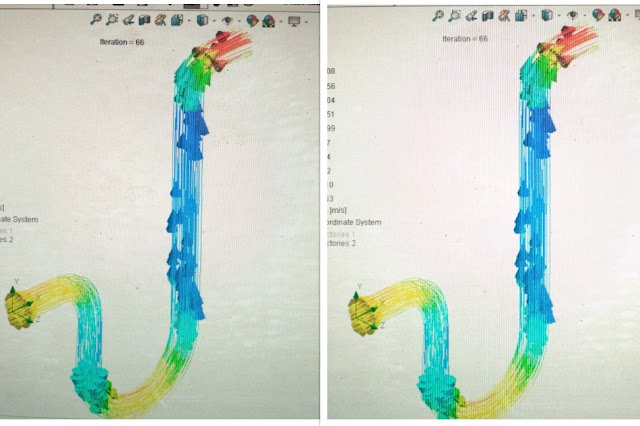
Solidworks Flow Simulation- is an intuitive Computational Fluid Dynamics (CFD) solution embedded within SOLIDWORKS 3D CAD that enables us to quickly and easily simulate liquid and gas flow through and around our designs to calculate product performance and capabilities. What is simulation ? Simulation is simply how a product or a part behaves under some fixed condition for ex if i push a square block with some force how the block behaves or changes its dimension (minimal) under that force, or suppose the door of your room is blocked and you are trying to open it by pushing it so how the door is going to behave and how much force you need to apply to open that one is given by simulation. Simulation is also used when the real system cannot be engaged, because it may not be accessible, or it may be dangerous or unacceptable to engage, or it is being designed but not yet built, or it may simply not exist. ex you have to design a car for your c...


Comments
Post a Comment